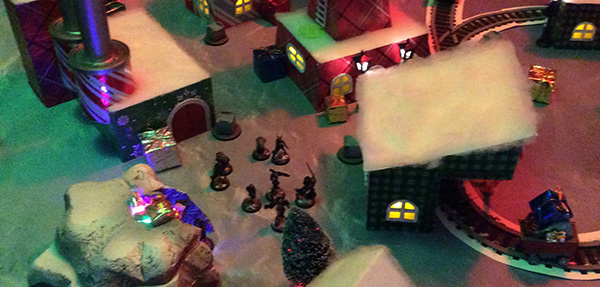
Sometimes I make pretty things.
Other times I make cool things.
And still other times, I make dumb things.
Today is a dumb thing.
Let’s make an Infinity-scale Christmas village.

Sometimes I make pretty things.
Other times I make cool things.
And still other times, I make dumb things.
Today is a dumb thing.
Let’s make an Infinity-scale Christmas village.

I have a computer-y job in a department with other computer-y people. Given this, I probably shouldn’t have been as surprised as I was when, as the department expanded during my decade-long tenure from 3 humans to 14, around half of the people in the department turned out to be nerds of various stripes. As a result, we do a bit of mild group nerdery within the department– mostly lunchtime boardgames and Magic, and regular conversations about video games, superhero movies, and so on.
During one of these departmental chats in July, one of the nerds mentioned Dungeons & Dragons, and his neighbour mentioned that he had never played it, but always wanted to try. Fast-forward a few weeks, and I ended up volunteering to run a few sessions of D&D after work to let any curious parties see what the game is like.
Because most of the players were brand new to D&D and I didn’t really relish the idea of starting the first session with a forty-minute lecture explaining the thirty-eight different character classes, I decided to try out an idea proposed by Matt Colville, who is a super thoughtful dude who posts DMing advice on YouTube: since I already owned a decent collection of painted miniatures, why not handle character creation by showing the players a variety of different minis, and then having each person pick the one that they find the coolest or most evocative.
I liked this idea for several reasons. First of all, instead of having to read through all of the classes in the game to decide what they wanted to play, each player just needs to consider the 2 or 3 classes that best match the mini they picked, which dramatically reduces the amount of complexity each of them needs to wade through. Also, on a more practical level, it allowed me to frontload any miniature painting before the campaign started instead of trying to paint minis and plan adventures at the same time.
I announced the proposal to my group (more on this later), and only then did I go home, open my D&D miniatures case, and come to two realizations:
After a bit of a delay caused by the size of the task unexpectedly quadrupling, I have finally finished updating my Classified Objective Deck for Season 10! You can download the new versions on my Infinity Tools page.

In addition to containing more objectives, the new cards needed indicators for several new elements– specialist icons, a differentiator for Normal/Extreme Mode, and– because my old cards were made before it existed– Intelcom. My old card design didn’t have any really convenient places to put these things, so I went ahead and completely redesigned the card layout to cleanly integrate the new elements. Doing this allowed me to shift things around and open up more space for the main text area, which should hopefully make things marginally easier to read.

There’s a goofy multiplayer format that we play in my local area. The first time we played it several years ago, someone lazily named it “Murderball”, and nobody has yet bothered to come up with a better name. In a nutshell: every player gets 100pts and always has 3 orders. When you get wiped out, you respawn a single Authorized Bounty Hunter that you can use to harass the players who are still in the game. It’s super fun. 🙂
We’ve used a large variety of proxy Bounty Hunters for Murderball over the years, but I wanted to have some proper dedicated models to use, so I decided to convert a squad of them using random models that I liked, with scratch-sculpted heads and scrounged weapons. And because I don’t want to bury the lead today, I’d like to answer the question in the post title by explaining WHY THEIR HEADS ARE SO BIG.
So, there you go. Some intention + some accident = bobblehead bounty hunters.

My sister is a better adult than I am. She has a more normal job, does normal human things like go outside and eat different food every day, and much to my relief, she volunteered to do the “family” thing. That last one was particularly appreciated for its effect of reducing certain lines of badgering from our shared mother, and the whole topic will be settled for good in a few months when Sandy provides my mom the grandchild she so stereotypically pines for.

I basically only have one friend, and it’s kind of surprising to me how well that’s working out.
If we were to rewind five or six years, I would be hanging out with quite a few different circles of people– all gamers of varying stripes, but technically still people. I had my D&D group; a handful of Warmachine players I was still close to despite having soured on the game itself; the Infinity group I had just started to poke my nose into; a small group of friends I met with on Tuesdays for cards and board games; and even a group of “my friend’s friends” whom I occasionally joined for random movies and games. In most of these groups, there would be people I enjoyed hanging out with, people who were… let’s go with “inoffensive”… and people for whom I spent considerable mental energy devising plans to avoid having to ever speak with.
Here is an approximate venn diagram of these groups circa 2012:
As you can see, I considered my entire board game group to be good friends, with maybe one or two people from every other group warranting semi-regular communication outside the physical confines of our gaming store. There were certainly positive aspects to having a social circle of this size, however it was also very stressful for me– people usually don’t guess this based on my hilarious, charming, and generally spectacular personality, but I’m actually quite introverted. I can put on a dazzling show for a few hours, but when it’s done, I need to crawl back into my dark cave and shut the world out while I recharge for a few days.